Mineralogical Society of America, Founded December 30, 1919
Order Publications Online (25% discount for MSA, CMS and GS members, except shipping)
MinPubs.org Pay-Per-View GeoScienceWorld Pay-Per-View
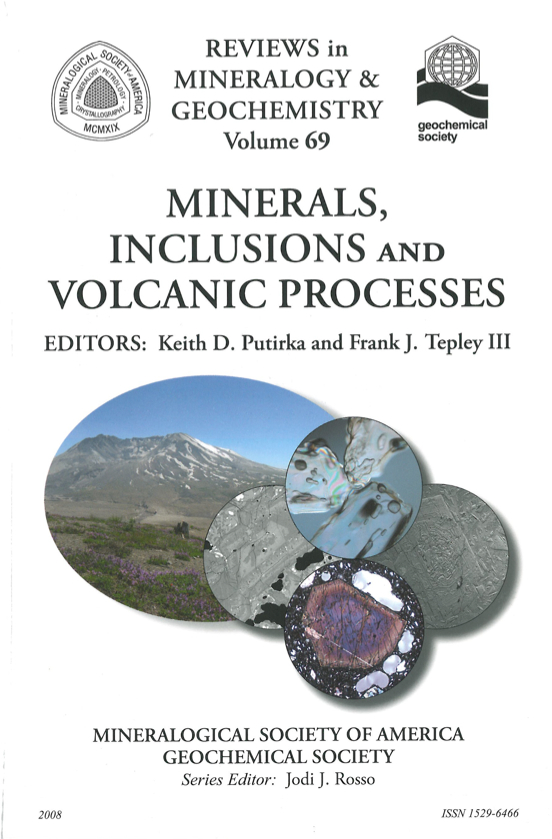
2008, i-xiv + 674 pages. ISBN 0-939950-83-9; ISBN13 978-0-939950-83-6
Minerals are intrinsically resistant to the processes that homogenize silicate liquids—their compositions thus yield an archive of volcanic and magmatic processes that are invisible at the whole rock scale. New experiments, and recent advances in micro-analytical techniques open a new realm of detail regarding the mineralogical record; this volume summarizes some of this progress. The alliance of the sub-fields reviewed in this volume bear upon fundamental issues of volcanology: At what depths are eruptions triggered, and over what time scales? Where and why do magmas coalesce before ascent? If magmas stagnate for thousands of years, what forces are responsible for initiating final ascent, or the degassing processes that accelerate upward motion? To the extent that we can answer these questions, we move towards formulating tests of mechanistic models of volcanic eruptions (e.g., Wilson, 1980; Slezin, 2003; Scandone et al., 2007), and hypotheses of the tectonic controls on magma transport (e.g., ten Brink and Brocher, 1987; Takada, 1994; Putirka and Busby, 2007). Our goal, in part, is to review how minerals can be used to understand volcanic systems and the processes that shape them; we also hope that this work will spur new and integrated studies of volcanic systems.
Our review begins by tracing the origins of mineral grains, and methods to estimate pressures (P) and temperatures (T) of crystallization. Hammer shows how "dynamic" experiments (conducted with varying P or T) yield important insights into crystal growth. Chapters by Putirka, Anderson, and Blundy and Cashman review various igneous geothermometers and geobarometers and introduce new calibrations. Among these chapters are many familiar models involving olivine, amphibole, feldspar, pyroxene, and spinel. Blundy and Cashman introduce new methods based on phase equilibria, and in another chapter, Hansteen and Klügel review P estimation based on densities of entrapped fluids and appropriate equations of state. Rutherford's chapter returns to the issue of disequilibrium, with a review of methods to estimate magma ascent rates, and a summary of results.
Our volume then moves to a review of melt inclusions. Kent shows how pre-mixed magma compositions can be preserved as inclusions, providing a window into pre-eruptive conditions. Métrich and Wallace review the volatile contents in basaltic melt inclusions and "magma degassing paths". Such methods rely upon vapor saturation pressures, which are derived from experimentally calibrated models. Chapters by Moore and Blundy and Cashman test two of the most important models, by Newman and Lowenstern (2002) (VolatileCalc) and Papale et al. (2006). Moore provides a guide to the appropriate use of these models, and their respective errors.
The next four chapters document insights obtained from isotopic studies and diffusion profiles. Ramos and Tepley review developments of micro-analytical isotope measurements, which now have the potential to elucidate even the most cryptic of open system behaviors. Cooper and Reid examine the time scales for such processes through U-series age dating techniques, and Bindeman reviews oxygen isotopes and their uses as tracers of both magmas and crystals. Costa then reviews yet another means to estimate the rates of magmatic processes, using mineral diffusion profiles, with important implications for magma processing.
In the next two chapters, Streck reviews an array of imaging methods and mineral textures, and their potential for disentangling mixed magmas, and Armienti takes a new look at the analysis of crystal size distributions (CSD), with applications to Mt. Etna. Our volume concludes with a chapter by Bachmann and Bergantz summarizing compositional zonations and a review of the thermal and compositional forces that drive open system behavior.
Finally, descriptions of many of the most common analytical approaches are also reviewed within these chapters. Analytical topics include: secondary ion mass spectrometry (Blundy and Cashman; Kent); electron microprobe (Blundy and Cashman; Kent; Métrich and Wallace; laser ablation ICP-MS (Kent; Ramos and Tepley); Fourier transform infrared spectroscopy (Moore; Métrich and Wallace); microsampling and isotope mass spectrometry (Ramos and Tepley); U-series measurement techniques (Cooper and Reid); Nomarski differential interference contrasts (Streck); micro-Raman spectroscopy (Métrich and Wallace); back-scattered electron microscopy, and cathodoluminescence (Blundy and Cashman).
As noted, our hope is that integrated studies can bring us closer to understanding how volcanic systems evolve and why eruptions occur. Our primary goal is to review how minerals can be used to understand volcanic systems; we also hope that this review might spur new and integrated studies of volcanic systems.
Keith D. Putirka, Fresno, California, USA
Frank J. Tepley, III, Corallis, Oregon, USA
November, 2008
REFERENCES
Microsoft Power Point Presentations (.ppt), Excel Spreadsheets or other programs given at the short course are included.
Title Page
p. i
Copyright
p. ii
From the Editors & Series Dedication
p. iii - iv
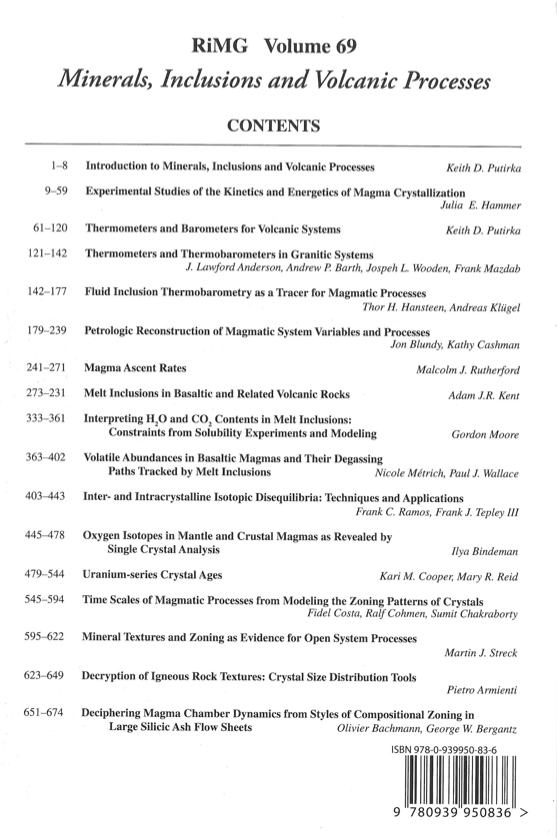
Table of Contents
p. v - xiv
Chapter 1. Introduction to Minerals, Inclusions and Volcanic Processes
by Keith D. Putirka, p. 1 - 8
Chapter 2. Experimental Studies of the Kinetics and Energetics of Magma Crystallization
by Julia E. Hammer, p. 9 - 60
Chapter 3. Thermometers and Barometers for Volcanic Systems
by Keith D. Putirka, p. 61 - 120
Chapter 4. Thermometers and Thermobarometers in Granitic Systems
by J. Lawford Anderson, Andrew P. Barth, Jospeh L. Wooden, and Frank Mazdab, p. 121 - 142
Chapter 5. Fluid Inclusion Thermobarometry as a Tracer for Magmatic Processes
by Thor H. Hansteen and Andreas Klügel, p. 143 - 178
Chapter 6. Petrologic Reconstruction of Magmatic System Variables and Processes
by Jon Blundy and Kathy Cashman, p. 179 - 240
Chapter 7. Magma Ascent Rates
by Malcolm J. Rutherford, p. 241 - 272
Chapter 8. Melt Inclusions in Basaltic and Related Volcanic Rocks
by Adam J.R. Kent, p. 273 - 332
Chapter 9. Interpreting H2O and CO2 Contents in Melt Inclusions: Constraints from Solubility Experiments and Modeling
by Gordon Moore, p. 333 - 362
Chapter 10. Volatile Abundances in Basaltic Magmas and Their Degassing Paths Tracked by Melt Inclusions
by Nicole Métrich and Paul J. Wallace, p. 363 - 402
Chapter 11. Inter- and Intracrystalline Isotopic Disequilibria: Techniques and Applications
by Frank C. Ramos and Frank J. Tepley III, p. 403 - 444
Chapter 12. Oxygen Isotopes in Mantle and Crustal Magmas as Revealed by Single Crystal Analysis
by Ilya Bindeman, p. 445 - 478
Chapter 13. Uranium-series Crystal Ages
by Kari M. Cooper, Mary R. Reid, p. 479 - 544
Chapter 14. Time Scales of Magmatic Processes from Modeling the Zoning Patterns of Crystals
by Fidel Costa, Ralf Dohmen, and Sumit Chakraborty, p. 545 - 594
Chapter 15. Mineral Textures and Zoning as Evidence for Open System Processes
by Martin J. Streck, p. 595 - 622
Chapter 16. Decryption of Igneous Rock Textures: Crystal Size Distribution Tools
by Pietro Armienti, p. 623 - 650
Chapter 17. Deciphering Magma Chamber Dynamics from Styles of Compositional Zoning in Large Silicic Ash Flow Sheets
by Olivier Bachmann and George W. Bergantz, p. 651 - 674
A collection of teaching activities on the topic of the volume has been made in collaboration with the On the Cutting Edge program for undergraduate faculty development in the geosciences. You can access these collections of teaching activities at:
http://serc.carleton.edu/NAGTWorkshops/petrology/minerals_inclusions_volcanic_processes.html. Check these out and plan to use these resources in your own classes.