Mineralogical Society of America, Founded December 30, 1919
Order Publications Online (25% discount for MSA, CMS and GS members, except shipping)
MinPubs.org Pay-Per-View GeoScienceWorld Pay-Per-View
2006 i-xx + 471 pages. ISBN 0-939950-75-8; ISBN13 978-0939950-75-1
For over half a century neutron scattering has added valuable information about the structure of materials. Unlike X-rays that have quickly become a standard laboratory technique and are available to all modern researchers in physics, chemistry, materials and earth sciences, neutrons have been elusive and reserved for specialists. A primary reason is that neutron beams, at least so far, are only produced at large dedicated facilities with nuclear reactors and accelerators and access to those has been limited. Yet there are a substantial number of experiments that use neutron scattering.
While earth science users are still a small minority, neutron scattering has nevertheless contributed valuable information on geological materials for well over half a century. Important applications have been in crystallography (e.g. atomic positions of hydrogen and Al-Si ordering in feldspars and zeolites, Mn-Fe-Ti distribution in oxides), magnetic structures, mineral physics at non-ambient conditions and investigations of anisotropy and residual strain in structural geology and rock mechanics. Applications range from structure determinations of large single crystals, to powder refinements and short-range order determination in amorphous materials. Zeolites, feldspars, magnetite, carbonates, ice, clathrates are just some of the minerals where knowledge has greatly been augmented by neutron scattering experiments. Yet relatively few researchers in earth sciences are taking advantage of the unique opportunities provided by modern neutron facilities. The goal of this volume, and the associated short course by the Mineralogical Society of America held December 7-9 in Emeryville/Berkeley CA, is to attract new users to this field and introduce them to the wide range of applications. As the following chapters will illustrate, neutron scattering offers unique opportunities to quantify properties of earth materials and processes.
Focus of this volume is on scientific applications but issues of instrumental availabilities and methods of data processing are also covered to help scientists from such diverse fields as crystallography, mineral physics, geochemistry, rock mechanics, materials science, biomineralogy become familiar with neutron scattering. A few years ago European mineralogists spearheaded a similar initiative that resulted in a special issue of the European Journal of Mineralogy (Volume 14, 2002). Since then the field has much advanced and a review volume that is widely available is highly desirable. At present there is really no easy access for earth scientists to this field and a more focused treatise can complement Bacon's (1955) book, now in its third edition, which is still a classic.
The purpose of this volume is to provide an introduction for those not yet familiar with neutrons by describing basic features of neutrons and their interaction with matter as well illustrating important applications. The volume is divided into 17 Chapters. The first two chapters introduce properties of neutrons and neutron facilities, setting the stage for applications. Some applications rely on single crystals (Chapter 3) but mostly powders (Chapters 4-5) and bulk polycrystals (Chapters 15-16) are analyzed, at ambient conditions as well as low and high temperature and high pressure (Chapters 7-9). Characterization of magnetic structures remains a core application of neutron scattering (Chapter 6). The analysis of neutron data is not trivial and crystallographic methods have been modified to take account of the complexities, such as the Rietveld technique (Chapter 4) and the pair distribution function (Chapter 11). Information is not only obtained about solids but about liquids, melts and aqueous solutions as well (Chapters 11-13). In fact this field, approached with inelastic scattering (Chapter 10) and small angle scattering (Chapter 13) is opening unprecedented opportunities for earth sciences. Small angle scattering also contributes information about microstructures (Chapter 14). Neutron diffraction has become a favorite method to quantify residual stresses in deformed materials (Chapter 16) as well as preferred orientation patterns (Chapter 15). The volume concludes with a short introduction into neutron tomography and radiography that may well emerge as a principal application of neutron scattering in the future (Chapter 17).
Rudy Wenk
Berkeley, California, USA
September, 2006
Title Page
p. i
Series Dedication & Copyright
p. ii
Volume Dedication
p. iii - iv
Preface
p. v - viii
Frequently used Symbols
p. ix - x
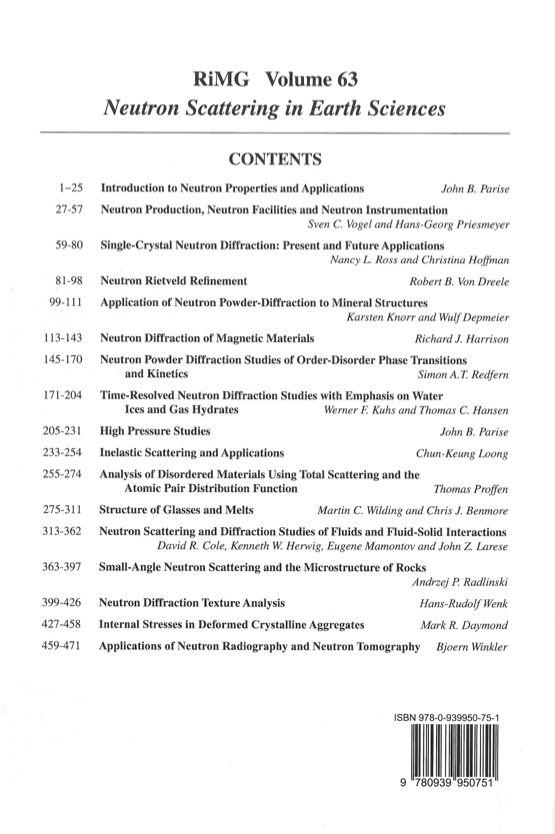
Table of Contents
p. xi - xx
Chapter 1. Introduction to Neutron Properties and Applications
by John B. Parise, p. 1 - 26
(PDF Version of PowerPoint Presentation 19.9 MB)
Chapter 2. Neutron Production, Neutron Facilities and Neutron Instrumentation
by Sven C. Vogel and Hans-Georg Priesmeyer, p. 27 - 58
Chapter 3. Single-Crystal Neutron Diffraction: Present and Future Applications
by Nancy L. Ross and Christina Hoffman, p. 59 - 80
(PDF Version of PowerPoint Presentation 14.9 MB)
Chapter 4. Neutron Rietveld Refinement
by Robert B. Von Dreele, p. 81 - 98
(PDF Version of PowerPoint Presentation 1.2 MB)
Chapter 5. Application of Neutron Powder-Diffraction to Mineral Structures
by Karsten Knorr and Wulf Depmeier, p. 99 - 112
(PDF Version of PowerPoint Presentation 1.8 MB)
Chapter 6. Neutron Diffraction of Magnetic Materials
by Richard J. Harrison, p. 113 - 144
(PDF Version of PowerPoint Presentation 7 MB)
Chapter 7. Neutron Powder Diffraction Studies of Order-Disorder Phase Transitions and Kinetics
by Simon A.T. Redfern, p. 145 - 170
(PDF Version of PowerPoint Presentation 44.5 MB)
Chapter 8. Time-Resolved Neutron Diffraction Studies with Emphasis on Water Ices and Gas Hydrates
by Werner F. Kuhs and Thomas C. Hansen, p. 171 - 204
(PDF Version of PowerPoint Presentation 4.3 MB)
Chapter 9. High Pressure Studies
by John B. Parise, p. 205 - 232
(PDF Version of PowerPoint Presentation 32.7 MB)
Chapter 10. Inelastic Scattering and Applications
by Chun-Keung Loong, p. 233 - 254
(PDF Version of PowerPoint Presentation 8.9 MB)
Chapter 11. Analysis of Disordered Materials Using Total Scattering and the Atomic Pair Distribution Function
by Thomas Proffen, p. 255 - 274
(PDF Version of PowerPoint Presentation 4.4 MB)
Chapter 12. Structure of Glasses and Melts
by Martin C. Wilding and Chris J. Benmore, p. 275 - 312
(PDF Version of PowerPoint Presentation 3.7 MB)
Chapter 13. Neutron Scattering and Diffraction Studies of Fluids and Fluid-Solid Interactions
by David R. Cole, Kenneth W. Herwig, Eugene Mamontov and John Z. Larese, p. 313 - 362
(PDF Version of PowerPoint Presentation 4 MB)
Chapter 14. Small-Angle Neutron Scattering and the Microstructure of Rocks
by Andrzej P. Radlinski, p. 363 - 398
Chapter 15. Neutron Diffraction Texture Analysis
by Hans-Rudolf Wenk, p. 399 - 426
(PDF Version of PowerPoint Presentation 12.6 MB)
Chapter 16. Internal Stresses in Deformed Crystalline Aggregates
by Mark R. Daymond, p. 427 - 458
Chapter 17. Applications of Neutron Radiography and Neutron Tomography
by Bjoern Winkler, p. 459 - 471
Special Presentation: Diffusion Studied by Quasi-elastic Neutron Scattering and Microscopic Simulation: Water in Clays.
By Natalie Malikova
(PDF Version of PowerPoint Presentation 5.7 MB)