Mineralogical Society of America, Founded December 30, 1919
Order Publications Online (25% discount for MSA, CMS and GS members, except shipping)
MinPubs.org Pay-Per-View GeoScienceWorld Pay-Per-View
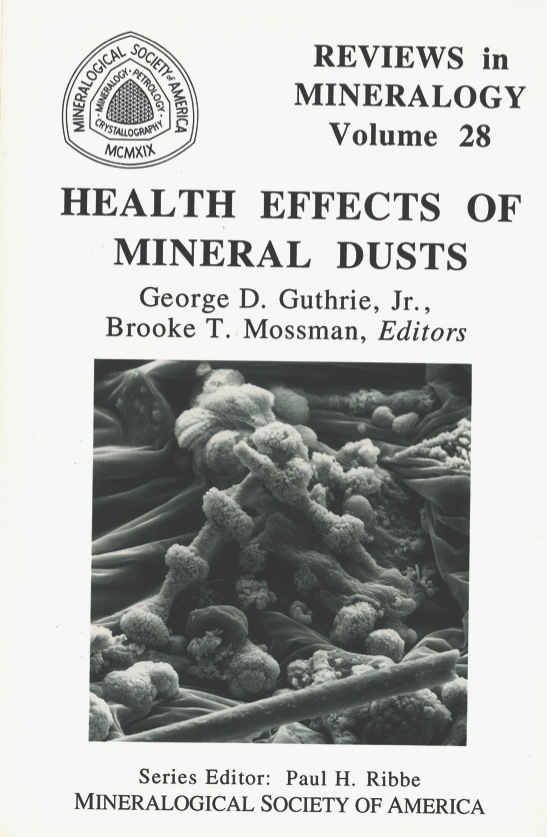
1993, i-xvi + 584 pages. ISBN 0-939950-33-2; ISBN13 978-0-939950-33-1
This volume represents the proceedings of a course by the same title held at Harbor House Resort and Conference Center on Nantucket Island off the coast of Massachusetts, October 22-24, 1993.
Numerous minerals are known to induce pulmonary diseases. The asbestos minerals (chrysotile and asbestiform amphiboles) are by far the most infamous. However, a number of silica polymorphs, clays, and zeolites have also been studied in great detail, as have several titania polymorphs, hematite, and magnetite (which are often used as negative controls in biological experiments). In fact, the relatively recent attention received by erionite (a fibrous zeolite) has arguably made it the most notorious of the minerals studied thus far.
The processes that lead to the development of disease (or pathogenesis) by minerals very likely occur at or near the mineral-fluid interface (as do many geochemical processes!). Thus the field of "mineral-induced pathogenesis" is a prime candidate for interdisciplinary research, involving mineral scientists, health scientists, petrologists, pathologists, geochemists, biochemists, and surface scientists, to name a few. The success of such an interdisciplinary approach rests on the ability of scientists in very different fields to communicate, and this is hampered by vocabulary barriers and an unfamiliarity with concepts, approaches, and problems. It can be difficult enough for a geoscientist or bioscientist to maintain fluency in the many fields tangential to his or her own field, and this problem is only exacerbated when one investigates problems that are crossdisciplinary. Nevertheless, important advances can be facilitated if these barriers are overcome.
This review volume and the short course upon which it was based are intended to provide some of the necessary tools for the researcher interested in this area of interdisciplinary research. The chapters present several of the important problems, concepts, and approaches from both the geological and biological ends of the spectrum. These two extremes are partially integrated throughout the book by cross-referencing between chapters. Chapter 1 also presents a general introduction into the ways in which these two areas overlap. However, many of the areas ripe for the interdisciplinarian will become obvious after reading the various chapters. The final chapter of this book discusses some of the regulatory aspects of minerals. Ultimately, the regulatory arena is where this type of interdisciplinary approach can make an impact, and hopefully better communication between all parties will accomplish this goal. A glossary is included at the end of this book, because the complexity of scientific terms in the two fields can thwart even the most enthusiastic of individuals.
George D. Guthrie, Jr., Los Alamos, New Mexico, USA
Brooke T. Mossman, Burlington, Vermont, USA
9 September 1993
Title Page
p. i
Copyright
p. ii
Foreword & Preface
p. iii - iv
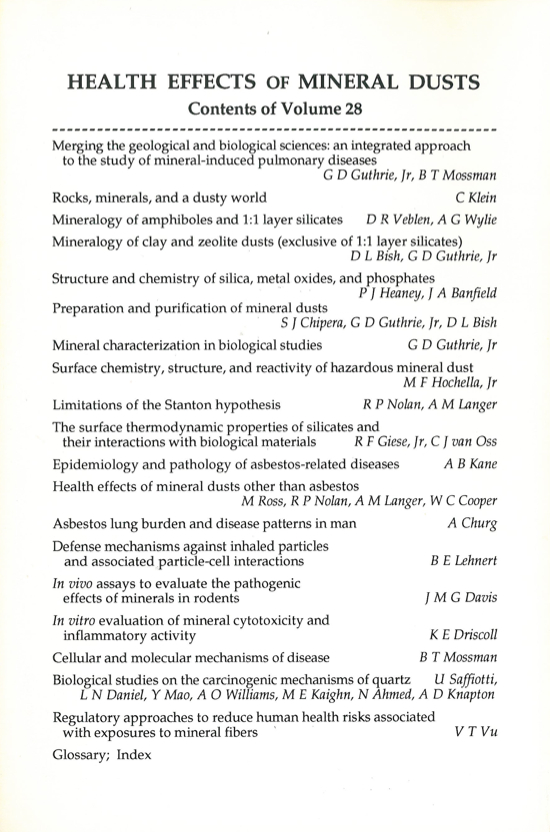
Table of Contents
p. v - xvi
Chapter 1. Merging the Geological and Biological Sciences: An Integrated Approach to the Study of Mineral-Induced Pulmonary Diseases
by George D. Guthrie, Jr. and Brooke T. Mossman, p. 1 - 6
Chapter 2. Rocks, Minerals, and a Dusty World
by Cornelius Klein, p. 7 - 60
Chapter 3. Mineralogy of Amphiboles and 1:1 Layer Silicates
by David R. Veblen and Ann G. Wylie, p. 61 - 138
Chapter 4. Mineralogy of Clay and Zeolite Dusts (Exclusive of 1:1 Layer Silicates)
by David L. Bish and George D. Guthrie, Jr., p. 139 - 184
Chapter 5. Structure and Chemistry of Silica, Metal Oxides, and Phosphates
by Peter J. Heaney and Jillian A. Banfield, p. 185 - 234
Chapter 6. Preparation and Purification of Mineral Dusts
by Steve J. Chipera, George D. Guthrie, Jr., and David L. Bish, p. 235 - 250
Chapter 7. Mineral Characterization in Biological Studies
by George D. Guthrie, Jr., p. 251 - 274
Chapter 8. Surface Chemistry, Structure, and Reactivity of Hazardous Mineral Dust
by Michael F. Hochella, Jr., p. 275 - 308
Chapter 9. Limitations of the Stanton Hypothesis
by Robert P. Nolan and Arthur M. Langer, p. 309 - 326
Chapter 10. The Surface Thermodynamic Properties of Silicates and Their Interactions with Biological Materials
by Rossman F. Giese, Jr. and Carel J. van Oss, p. 327 - 346
Chapter 11. Epidemiology and Pathology of Asbestos-Related Diseases
by Agnes B. Kane, p. 347 - 360
Chapter 12. Health Effects of Mineral Dusts Other Than Asbestos
by Malcolm Ross, Robert P. Nolan, Arthur M. Langer, and W. Clark Cooper, p. 361 - 408
Chapter 13. Asbestos Lung Burden and Disease Patterns in Man
by Andrew Churg, p. 409 - 426
Chapter 14. Defense Mechanisms Against Inhaled Particles and Associated Particle-Cell Interactions
by Bruce E. Lehnert, p. 427 - 470
Chapter 15. In Vivo Assays to Evaluate the Pathogenic Effects of Minerals in Rodents
by John M. G. Davis, p. 471 - 488
Chapter 16. In Vitro Evaluation of Mineral Cytotoxicity and Inflammatory Activity
by Kevin E. Driscoll, p. 489 - 512
Chapter 17. Cellular and Molecular Mechanisms of Disease
by Brooke T. Mossman, p. 513 - 522
Chapter 18. Biological Studies on the Carcinogenic Mechanisms of Quartz
by Umberto Saffiotti, Lambert N. Daniel, Yan Mao, A. Olufemi Williams, M. Edward Kaighn, Nadera Ahmed, and Alan D. Knapton, p. 523 - 544
Chapter 19. Regulatory Approaches to Reduce Human Health Risks Associated with Exposures to Mineral Fibers
by V. T. Vu, p. 545 - 554
Glossary, p. 555 - 576
Index, p. 577 - 584.