Mineralogical Society of America, Founded December 30, 1919
Order Publications Online (25% discount for MSA, CMS and GS members, except shipping)
MinPubs.org Pay-Per-View GeoScienceWorld Pay-Per-View
1991, i-xvi + 672 pages. ISBN 0-939950-31-6; ISBN13 978-0-939950-31-7
The Mineralogical Society of America sponsored a short course on Contact Metamorphism, October 17-19, 1991, at the Pala Mesa Resort, Fallbrook, California, prior to its annual meeting with the Geological Society of America. As reviewed in Chapter 1, contact aureoles have unique attributes for elucidating the processes and controls of metamorphism. Within the last two decades there has been considerable evolution in our knowledge of metamorphism. This evolution spans a wide range of scales from submicroscopic analysis of grain boundaries through to regional scale analysis of contact metamorphism associated with batholith terrains. Geological sciences is becoming increasingly multidisciplinary in nature. Traditionally, contact aureoles were primarily studied by metamorphic petrologists. Their mapping of isograds and mineral zones in aureoles, coupled with microscopic analysis of the prograde metamorphic evolution of textures, structures and mineralogy, has provided an excellent framework for our understanding of contact metamorphism. However, complete understanding of the processes and controls of contact metamorphism requires a multidisciplinary analysis from a wide range of geological subdisciplines. This volume provides a multidisciplinary review of our current knowledge of contact metamorphism. As in any field of endeavor, we are provided with new questions, thereby dictating future directions of study. Hopefully, this volume will provide inspiration and direction for future research on contact metamorphism.
Derrill M. Kerrick, University Park, Pennsylvania, USA
September 3, 1991
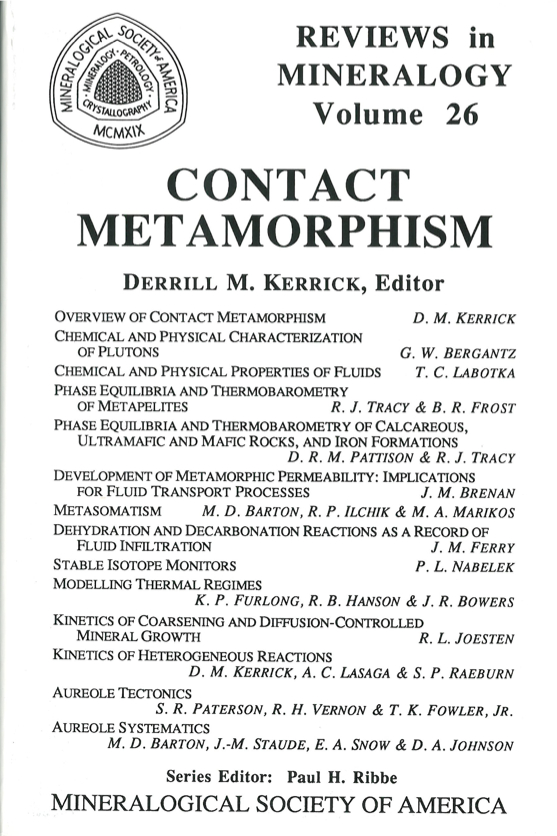
Title Page
p. i
Copyright
p. ii
Foreword, Preface, & Acknowldegements
p. iii
Table of Contents
p. iv - xvi
Chapter 1. Overview of Contact Metamorphism
by Derrill M. Kerrick, p. 1 - 12
Chapter 2. Chemical and Physical Characterization of Plutons
by George W. Bergantz, p. 13 - 42
Chapter 3. Chemical and Physical Properties of Fluids
by Theodore C. Labotka, p. 43 - 104
Errata for Chapter 3 (html, pdf)
The authors for Chapters 4 and 5 on the front cover have been reversed. They are correct on this page
Chapter 4. Phase Equilibria and Thermobarometry of Metapelites
by David R. M. Pattison and Robert J. Tracy, p. 105 - 206
Errata for Chapter 4 (html, pdf)
Chapter 5. Phase Equilibria and Thermobarometry of Calcareous, Ultramafic and Mafic Rocks, and Iron Formations
by Robert J. Tracy and B. Ronald Frost, p. 207 - 290
Errata for Chapter 5 (html, pdf)
Chapter 6. Development of Metamorphic Permeability: Implications for Fluid Transport Processes
by James M. Brenan, p. 291 - 320
Chapter 7. Metasomatism
by Mark D. Barton, Robert P. Ilchik, and Mark A. Marikos, p. 321 - 350
Chapter 8. Dehydration and Decarbonation Reactions as a Record of Fluid Infiltration
by John M. Ferry, p. 351 - 394
Chapter 9. Stable Isotope Monitors
by Peter L. Nabelek, p. 395 - 436
Chapter 10. Modelling Thermal Regimes
by Kevin P. Furlong, R. Brooks Hanson, and James R. Bowers, p. 437 - 506
Chapter 11. Kinetics of Coarsening and Diffusion-Controlled Mineral Growth
by Raymond L. Joesten, p. 507 - 582
Chapter 12. Kinetics of Heterogeneous Reactions
by Derrill M. Kerrick, Anthony C. Lasaga, and Stuart P. Raeburn, p. 583 - 672
Chapter 13. Aureole Tectonics
by Scott R. Paterson, Ron H. Vernon, and T. Kenneth Fowler, Jr., p. 673 - 722
Chapter 14. Aureole Systematics
by Mark D. Barton, John-Mark Staude, Eleanour A. Snow, and David A. Johnson, p. 723-847