Mineralogical Society of America, Founded December 30, 1919
Order Publications Online (25% discount for MSA, CMS and GS members, except shipping)
MinPubs.org Pay-Per-View GeoScienceWorld Pay-Per-View
2007, i-xxv + 545 pages. ISBN 0-939950-79-0; ISBN13 978-0-939950-79-9
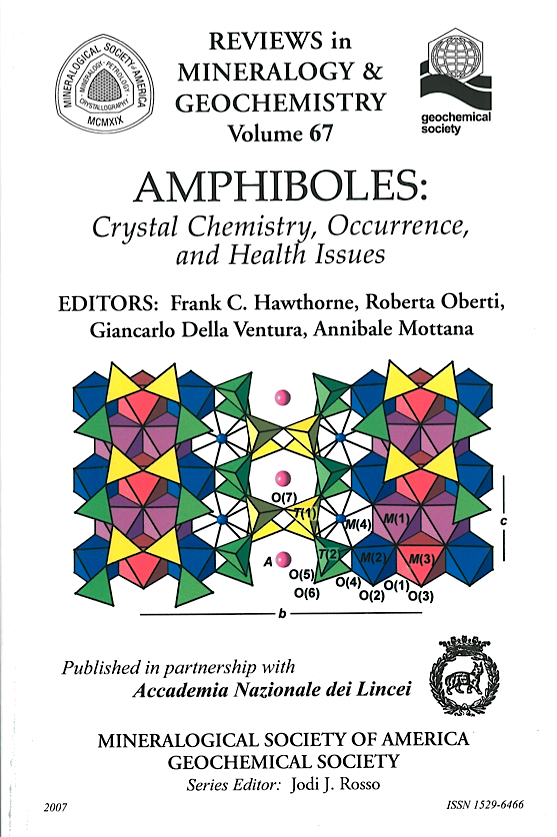
Over 25 years ago, Volume 9 of Reviews in Mineralogy: Amphiboles and Other Hydrous Pyriboles seemed to contain all that was possible to know about this group of fascinating minerals. The subsequent twenty-five years have shown that this assessment was wrong: Nature was keeping a lot in reserve, and has since revealed considerable new complexity in the constitution and behavior of amphiboles. Some of the advances in knowledge have been due to the use of new experimental techniques, some have been due to the investigation of hitherto neglected rock-types, and some have been due to the development of new ideas.
The current volume has taken a different approach from previous volumes concerned with major groups of rock-forming minerals. Some of the contents have previously been organized by the investigative technique or groups of similar techniques: crystal-structure refinement, spectroscopy, TEM etc. Here, we have taken an approach that focuses on aspects of amphiboles rather than experimental techniques: crystal chemistry, new compositions, long-range order, short-range order etc., and all experimental results germane to these topics are discussed in each chapter. The intent of this approach is to focus on amphiboles, and to emphasize that many techniques are necessary to fully understand each aspect of the amphiboles and their behavior in both natural and industrial processes.
Frank C. Hawthorne, Winnipeg, Canada
Roberta Oberti, Pavia, Italy
Giancarlo Della Ventura, Roma, Italy
Annibale Mottana, Roma, Italy
August, 2007
Title Page
p. i
Copyright
p. ii
From the Editors & Preface
p. iii - iv
Table of Contents
p. v - xvi
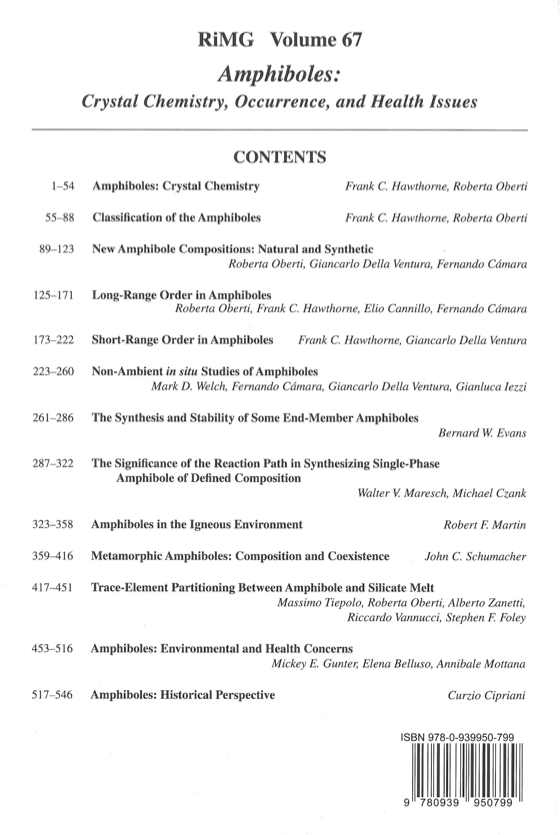
Chapter 1. Amphiboles: Crystal Chemistry
by Frank C. Hawthorne and Roberta Oberti, p. 1 - 54
Chapter 2. Classification of the Amphiboles
by Frank C. Hawthorne and Roberta Oberti, p. 55 - 88
Chapter 3. New Amphibole Compositions: Natural and Synthetic
by Roberta Oberti, Giancarlo Della Ventura, and Fernando Cámara, p. 89 - 124
Chapter 4. Long-Range Order in Amphiboles
by Roberta Oberti, Frank C. Hawthorne, Elio Cannillo, and Fernando Cámara, p. 125 - 172
Chapter 5. Short-Range Order in Amphiboles
by Frank C. Hawthorne and Giancarlo Della Ventura, p. 173 - 222
Chapter 6. Non-Ambient in situ Studies of Amphiboles
by Mark D. Welch, Fernando Camara, Giancarlo Della Ventura, and Gianluca Iezzi, p. 223 - 260
Chapter 7. The Synthesis and Stability of Some End-Member Amphiboles
by Bernard W. Evans, p. 261 - 286
Chapter 8. The Significance of the Reaction Path in Synthesizing Single-Phase Amphibole of Defined Composition
by Walter V. Maresch and Michael Czank, p. 287 - 322
Chapter 9. Amphiboles in the Igneous Environment
by Robert F. Martin, p. 323 - 358
Chapter 10. Metamorphic Amphiboles: Composition and Coexistence
by John C. Schumacher, p. 359 - 416
Chapter 11. Trace-Element Partitioning Between Amphibole and Silicate Melt
by Massimo Tiepolo, Roberta Oberti, Alberto Zanetti, Riccardo Vannucci, and Stephen F. Foley, p. 417 - 452
Chapter 12. Amphiboles: Environmental and Health Concerns
by Mickey E. Gunter, Elena Belluso, and Annibale Mottana, p. 453 - 516
Chapter 13. Amphiboles: Historical Perspective
by Curzio Cipriani, p. 517 - 546