Mineralogical Society of America, Founded December 30, 1919
Order Publications Online (25% discount for MSA, CMS and GS members, except shipping)
MinPubs.org Pay-Per-View GeoScienceWorld Pay-Per-View
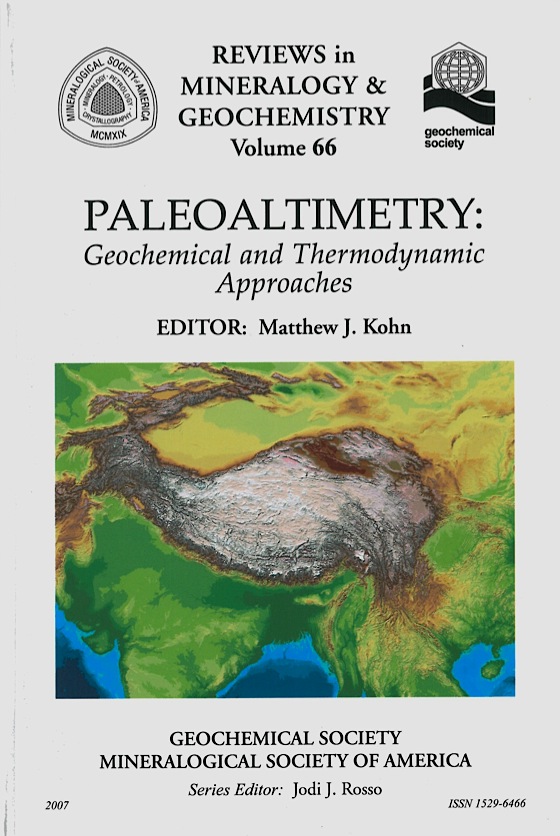
2007, i-x + 278 pages. ISBN 0-939950-78-2; ISBN13 978-0-939950-78-2
The idea for this book was conceived in early June, 2005 at a paleoaltimetry workshop held at Lehigh University, Lehigh, Pennsyalvania and organized by Dork Sahagian. The workshop was funded by the tectonics program at NSF, and was designed to bring together researchers in paleoaltimetry to discuss different techniques and focus the community on ways of improving paleoelevation estimates and consequent interpretations of geodynamics and tectonics. At this meeting, some commented that a comprehensive volume describing the different methods could help advance the field. I offered to contact the Mineralogical Society of America and the Geochemical Society about publishing a RiMG volume on paleoaltimetry. Because many of the techniques used to infer paleoelevations are geochemically-based or deal with thermodynamic principles, the GS and MSA agreed to the project. Two years and roughly 1000 e-mails later, our book has arrived.
The book is organized into 4 sections:
Some chapters overlap in general content (e.g., basic principles of stable isotopes in precipitation are covered to different degrees in all stable isotope chapters), but no attempt was made to limit authors' discussion of principles, or somehow attempt to arrive at a "consensus view" on any specific topic. Because science advances by critical discussion of concepts, such restrictions were viewed as counterproductive. This does mean that different chapters may present different views on reliability of paleoelevation estimates, and readers are advised to read other chapters in the book on related topics – they may be more closely linked than they might at first appear!
I hope readers of this book will discover and appreciate the synergy among paleoaltimetry, climate change, and tectonic geomorphology. These interrelationships create a complex, yet rich field of scientific enquiry that in turn offers insights into climate and geodynamics.
Matthew J. Kohn, Boise, Idaho, USA
August, 2007
Title Page
p. i
Copyright & Series Dedication
p. ii
From the Editors & Preface
p. iii - iv
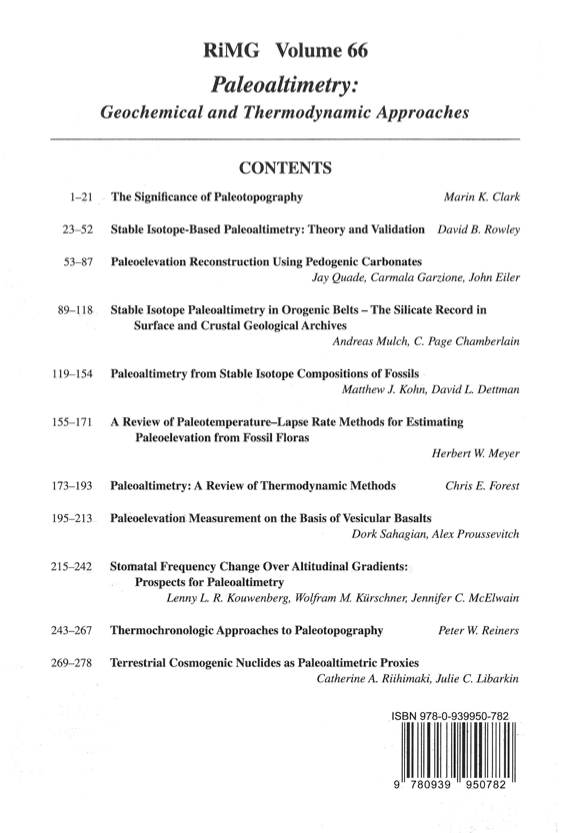
Table of Contents
p. v - x
Chapter 1. The Significance of Paleotopography
by Marin K. Clark, p. 1 - 22
Chapter 2. Stable Isotope-Based Paleoaltimetry: Theory and Validation
by David B. Rowley, p. 23 - 52
Chapter 3. Paleoelevation Reconstruction Using Pedogenic Carbonates
by Jay Quade, Carmala Garzione, and John Eiler, p. 53 - 88
Chapter 4. Stable Isotope Paleoaltimetry in Orogenic Belts – The Silicate Record in Surface and Crustal Geological Archives
by Andreas Mulch and C. Page Chamberlain, p. 89 - 118
Chapter 5. Paleoaltimetry from Stable Isotope Compositions of Fossils
by Matthew J. Kohn and David L. Dettman, p. 119 - 154
Chapter 6. A Review of Paleotemperature–Lapse Rate Methods for Estimating Paleoelevation from Fossil Floras
by Herbert W. Meyer, p. 155 - 172
Chapter 7. Paleoaltimetry: A Review of Thermodynamic Methods
by Chris E. Forest, p. 173 - 194
Chapter 8. Paleoelevation Measurement on the Basis of Vesicular Basalts
by Dork Sahagian and Alex Proussevitch, p. 195 - 214
Chapter 9. Stomatal Frequency Change Over Altitudinal Gradients: Prospects for Paleoaltimetry
by Lenny L. R. Kouwenberg, Wolfram M. Kürschner, and Jennifer C. McElwain, p. 215 - 242
Chapter 10. Thermochronologic Approaches to Paleotopography
by Peter W. Reiners, p. 243 - 268
Chapter 11. Terrestrial Cosmogenic Nuclides as Paleoaltimetric Proxies
by Catherine A. Riihimaki and Julie C. Libarkin, p. 269 - 278