Mineralogical Society of America, Founded December 30, 1919
Order Publications Online (25% discount for MSA, CMS and GS members, except shipping)
MinPubs.org Pay-Per-View GeoScienceWorld Pay-Per-View
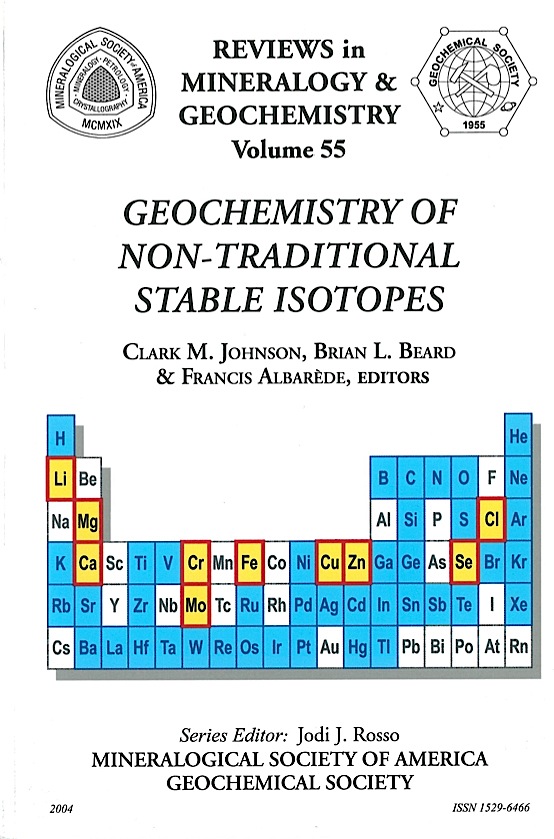
2004 i-xvi + 454 pages. ISBN 0-939950-67-7; ISBN13 978-0-939950-67-6
Until only a few years ago, I would never have imagined that a volume on the stable isotope geochemistry of elements like Mg, Fe or Cu would be written. In fact, a comic book of blank pages entitled The Stable Isotope Geochemistry of Fluorine would have been a more likely prospect. In volume 16 of this series, published in 1986, I wrote: Isotopic variations have been looked for but not found for heavy elements like Cu, Sn, and Fe .... Natural variations in isotopic ratios of terrestrial materials have been reported for other light elements like Mg and K, but such variations usually turn out to be laboratory artifacts. I am about ready to eat those words.
We have known for many years that large isotopic fractionations of heavy elements like Pb develop in the source regions of TIMS machines. Nonetheless, most of us held fast to the conventional wisdom that no significant mass-dependent isotopic fractionations were likely to occur in natural or laboratory systems for elements that are either heavy or engaged in bonds with a dominant ionic character. With the relatively recent appearance of new instrumentation like MC-ICP-MS and heroic methods development in TIMS analyses, it became possible to make very precise measurements of the isotopic ratios of some of these non-traditional elements, particularly if they comprise three or more isotopes. It was eminently reasonable to reexamine these systems in this new light. Perhaps atomic weights could be refined, or maybe there were some unexpected isotopic variations to discover. There were around the turn of the present century, reports began appearing of biological fractionations of about 2-3 per mil for heavy elements like Fe and Cr and attempts were made to determine the magnitude of equilibrium isotope effects in these systems, both by experiment and semi-empirical calculations. Interest emerged in applying these effects to the study of environmental problems. Even the most recalcitrant skeptic now accepts the fact that measurable and meaningful variations in the isotopic ratios of heavy elements occur as a result of chemical, biological and physical processes.
Most of the work discussed in this volume was published after the year 2000 and thus the chapters are more like progress reports rather than reviews. Skepticism now focuses on whether isotopic variations as small as 0.1 per mil are indeed as meaningful as some think, and the fact that measured isotopic fractionations of these non-traditional elements are frequently much smaller than predicted from theoretical considerations. In fact the large fractionations suggested by the calculations provide much of the stimulus for working in this discipline. Clearly some carefully designed experiments could shed light on some of the ambiguity. My optimism for the future of this burgeoning new field remains high because it is in very good hands indeed.
James R. O'Neil
Ann Arbor, Michigan, USA
Approximately three-quarters of the elements in the Periodic Table have two or more isotopes. RiM 16 and RiMG 43 were devoted to H, C, 0, and S isotope variations, and B isotope variations were discussed in RiM 33. The importance of these elements to geochemistry may be illustrated by a GeoRef search of 0 isotope publications, which yields over 25,000 papers, theses, and abstracts spanning over five decades. Isotopic variations of the remaining 56 elements that have two or more isotopes, however, remains relatively little explored, but is gaining rapid attention, in part driven by advances in analytical instrumentation in the last 5-10 years. Our goal for this volume was to bring together a summary of the isotope geochemistry of non-traditional stable isotope systems as is known through 2003 for those elements that have been studied in some detail, and which have a variety of geochemical properties. In addition, recognizing that many of these elements are of interest to workers who are outside the traditional stable isotope fields, we felt it was important to include discussions on the broad isotopic variations that occur in the solar system, theoretical approaches to calculating isotopic fractionations, and the variety of analytical methods that are in use. We hope, therefore, that this volume proves to be useful to not only the isotope specialist, but to others who are interested in the contributions that these non-traditional stable isotopes may make toward understanding geochemical and biological cycles.
The review chapters in this volume were the basis for a two-day short course on nontraditional stable isotopes held prior (May 15-16, 2004) to the spring AGU/CGU Meeting in Montreal, Canada.
Clark M. Johnson, Madison, Wisconsin, USA
Brian L. Beard, Madison, Wisconsin, USA
Francis Albarede, Lyon, France
March, 2004
Title Page
p. i
Copyright
p. ii
Dedication
p. iii - iv
Foreword, Preface & Acknowledgments
p. v - vi
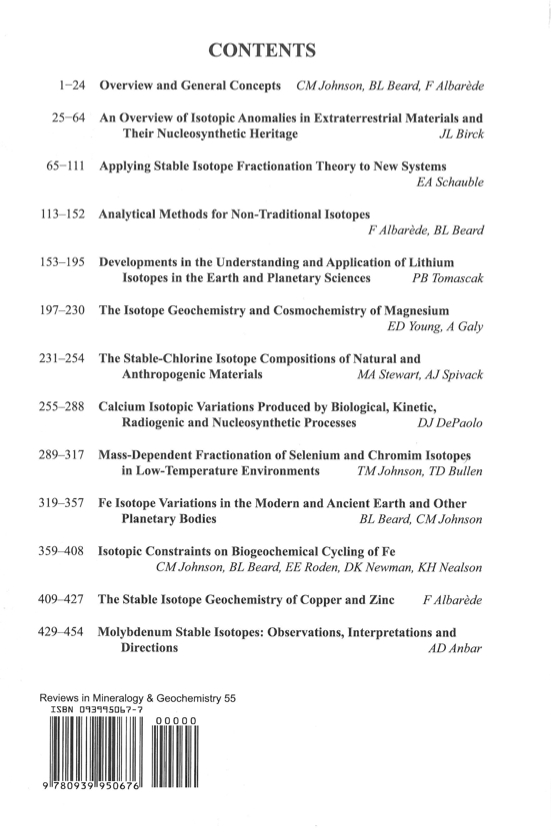
Table of Contents
p. vii - xvi
Chapter 1. Overview and General Concepts
by Clark M. Johnson, Brian L. Beard and Francis Albarede, p. 1 - 24
Chapter 2. An Overview of Isotopic Anomalies in Extraterrestrial Materials and Their Nucleosynthetic Heritage
by Jean Louis Birck, p. 25 - 64
Chapter 3. Applying Stable Isotope Fractionation Theory to New Systems
by Edwin A. Schauble, p. 65 - 112
Errata for Chapter 3 pdf or html
Chapter 4. Analytical Methods for Non-Traditional Isotopes
by Francis AlbarÀde and Brian L. Beard, p. 113 - 152
Errata for Chapter 4 pdf or html
Chapter 5. Developments in the Understanding and Application of Lithium Isotopes in the Earth and Planetary Sciences
by Paul B. Tomascak, p. 153 - 196
Chapter 6. The Isotope Geochemistry and Cosmochemistry of Magnesium
by Edward D. Young and Albert Galy, p. 197 - 230
Chapter 7. The Stable-Chlorine Isotope Compositions of Natural and Anthropogenic Materials
by Michael A. Stewart and Arthur J. Spivack, p. 231 - 254
Chapter 8. Calcium Isotopic Variations Produced by Biological, Kinetic, Radiogenic and Nucleosynthetic Processes
by Donald J. DePaolo, p. 255 - 288
Chapter 9. Mass-Dependent Fractionation of Selenium and Chromium Isotopes in Low-Temperature Environments
by by Thomas M. Johnson and Thomas D. Bullen, p. 289 - 318
Chapter 10A. Fe Isotope Variations in the Modern and Ancient Earth and Other Planetary Bodies
by Brian L. Beard and Clark M. Johnson, p. 319 - 358
Chapter 10B. Isotopic Constraints on Biogeochemical Cycling of Fe
by Clark M. Johnson, Brian L. Beard, Eric E. Roden, Dianne K. Newman and Kenneth H. Nealson, p. 359 - 408
Chapter 11. The stable isotope geochemistry of copper and zinc
by Francis Albarede, p. 409 - 428
Chapter 12. Molybdenum Stable Isotopes: Observations, Interpretations and Directions
by Ariel D. Anbar, p. 429 - 454