Mineralogical Society of America, Founded December 30, 1919
Order Publications Online (25% discount for MSA, CMS and GS members, except shipping)
MinPubs.org Pay-Per-View GeoScienceWorld Pay-Per-View
2002 i-xxii + 579 pages. ISBN 0-939950-61-8; ISBN13 978-0-939950-61-4
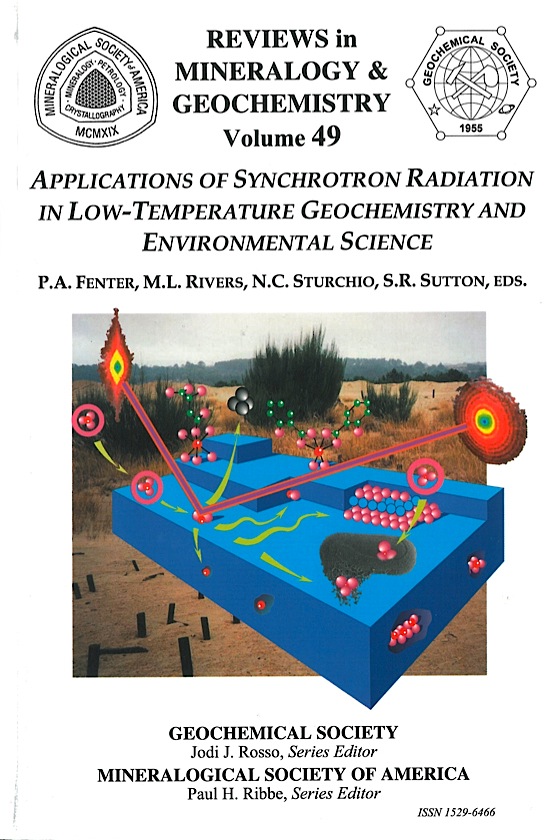
This volume was produced in response to the need for a comprehensive introduction to the continually evolving state of the art of synchrotron radiation applications in low-temperature geochemistry and environmental science. It owes much to the hard work and imagination of the devoted cadre of sleep-deprived individuals who blazed a trail that many others are beginning to follow. Synchrotron radiation methods have opened new scientific vistas in the earth and environmental sciences, and progress in this direction will undoubtedly continue.
The organization of this volume is as follows. Chapter 1 (Brown and Sturchio) gives a fairly comprehensive overview of synchrotron radiation applications in low temperature geochemistry and environmental science. The presentation is organized by synchrotron methods and scientific issues. It also has an extensive reference list that should prove valuable as a starting point for further research. Chapter 2 (Sham and Rivers) describes the ways that synchrotron radiation is generated, including a history of synchrotrons and a discussion of aspects of synchrotron radiation that are important to the experimentalist.
The remaining chapters of the volume are organized into two groups. Chapters 3 through 6 describe specific synchrotron methods that are most useful for single-crystal surface and mineral-fluid interface studies. Chapters 7 through 9 describe methods that can be used more generally for investigating complex polyphase fine-grained or amorphous materials, including soils, rocks, and organic matter.
Chapter 2 (Shearer) reviews the behavior of Be in the Solar System, with an emphasis on meteorites, the Moon and Mars, and the implications of this behavior for the evolution of the solar system. Chapter 3 (Ryan) is an overview of the terrestrial geochemistry of Be, and Chapter 7 (Vesely, Norton, Skrivan, Majer, Kr·m, Navr·til, and Kaste) discusses the contamination of the environment by this anthropogenic toxin.
Chapter 3 (Fenter) presents the elementary theory of synchrotron X-ray reflectivity along with examples of recent applications, with emphasis on in situ studies of mineral-fluid interfaces. Chapter 4 (Bedzyk and Cheng) summarizes the theory of X-ray standing waves (XSW), the various methods for using XSW in surface and interfaces studies, and gives a brief review of recent applications in geochemistry and mineralogy. Chapter 5 (Waychunas) covers the theory and applications of grazing-incidence X-ray absorption and emission spectroscopy, with recent examples of studies at mineral surfaces. Chapter 6 (Hirschmugl) describes the theory and applications of synchrotron infrared microspectroscopy.
Chapter 7 (Manceau, Marcus, and Tamura) gives background and examples of the combined application of synchrotron X-ray microfluorescence, microdiffraction, and microabsorption spectroscopy in characterizing the distribution and speciation of metals in soils and sediments. Chapter 8 (Sutton, Newville, Rivers, Lanzirotti, Eng, and Bertsch) demonstrates a wide variety of applications of synchrotron X-ray microspectroscopy and microtomography in characterizing earth and environmental materials and processes. Finally, Chapter 9 (Myneni) presents a review of the principles and applications of soft X-ray microspectroscopic studies of natural organic materials.
All of these chapters review the state of the art of synchrotron radiation applications in low temperature geochemistry and environmental science, and offer speculations on future developments. The reader of this volume will acquire an appreciation of the theory and applications of synchrotron radiation in low temperature geochemistry and environmental science, as well as the significant advances that have been made in this area in the past two decades (especially since the advent of the third-generation synchrotron sources). We hope that this volume will inspire new users to "see the light" and pursue their research using the potent tool of synchrotron radiation.
Paul A. Fenter, Mark L. Rivers, Neil C. Sturchio, and Stephen R. Sutton
Chicago, Illinois, USA
September 25, 2002
Title Page
p. i
Copyright
p. ii
Dedication
p. iii - iv
Foreword, Preface & Acknowledgments
p. v - vi
The Authors
p. vii - xiv
Table of Contents
p. xv - xxii
Chapter 1. An Overview of Synchrotron Radiation Applications to Low Temperature Geochemistry and Environmental Science
by Gordon E. Brown, Jr. and Neil C. Sturchio, p. 1 - 116
Chapter 2. A Brief Overview of Synchrotron Radiation
by T. K. Sham and Mark L. Rivers, p. 117 - 148
Chapter 3. X-ray Reflectivity as a Probe of Mineral-Fluid Interfaces: A User Guide
by Paul A. Fenter, p. 149 - 220
Chapter 4. X-ray Standing Wave Studies of Minerals and Mineral Surfaces: Principles and Applications
by Michael J. Bedzyk and Likwan Cheng, p. 221 - 266
Chapter 5. Grazing-incidence X-ray Absorption and Emission Spectroscopy
by Glenn A. Waychunas, p. 267 - 316
Chapter 6. Applications of Storage Ring Infrared Spectromicroscopy and Reflection-Absorption Spectroscopy to Geochemistry and Environmental Science
by Carol J. Hirschmugl, p. 317 - 340
Chapter 7. Quantitative Speciation of Heavy Metals in Soils and Sediments by Synchrotron X-ray Techniques
by Alain Manceau, Matthew A. Marcus, and Nobumichi Tamura, p. 341 - 428
Chapter 8. Microfluorescence and MicrotomographyAnalyses of Heterogeneous Earth and Environmental Materials
by Stephen R. Sutton, Paul M. Bertsch, Matthew Newville, Mark Rivers, Antonio Lanzirotti and Peter Eng, p. 429 - 484
Chapter 9. Soft X-ray Spectroscopy and Spectromicroscopy Studies of Organic Molecules in the Environment
by Satish C. B. Myneni, p. 485 - 579