Mineralogical Society of America, Founded December 30, 1919
Order Publications Online (25% discount for MSA, CMS and GS members, except shipping)
MinPubs.org Pay-Per-View GeoScienceWorld Pay-Per-View
2000 i-x + 361 pages. ISBN 0-939950-51-0; ISBN13 978-0-939950-51-5
Phase transformations occur in most types of materials, including ceramics, metals, polymers, diverse organic and inorganic compounds, minerals, and even crystalline viruses. They have been studied in almost all branches of science, but particularly in physics, chemistry, engineering, materials science and earth sciences. In some cases the objective has been to produce materials in which phase transformations are suppressed, to preserve the structural integrity of some engineering product, for example, while in other cases the objective is to maximise the effects of a transformation, so as to enhance properties such as superconductivity, for example. A long tradition of studying transformation processes in minerals has evolved from the need to understand the physical and thermodynamic properties of minerals in the bulk earth and in the natural environment at its surface. The processes of interest have included magnetism, ferroelasticity, ferroelectricity, atomic ordering, radiation damage, polymorphism, amorphisation and many others-in fact there are very few minerals which show no influence of transformation processes in the critical range of pressures and temperatures relevant to the earth. As in all other areas of science, an intense effort has been made to tum qualitative understanding into quantitative description and prediction via the simultaneous development of theory, experiments and simulations. In the last few years rather fast progress has been made in this context, largely through an interdisciplinary effort, and it seemed to us to be timely to produce a review volume for the benefit of the wider scientific community which summarises the current state of the art. The selection of transformation processes covered here is by no means comprehensive, but represents a coherent view of some of the most important processes which occur specifically in minerals.
Simon A. T. Redfern and Michael A. Carpenter
Cambridge, England, United Kingdom
July, 2000
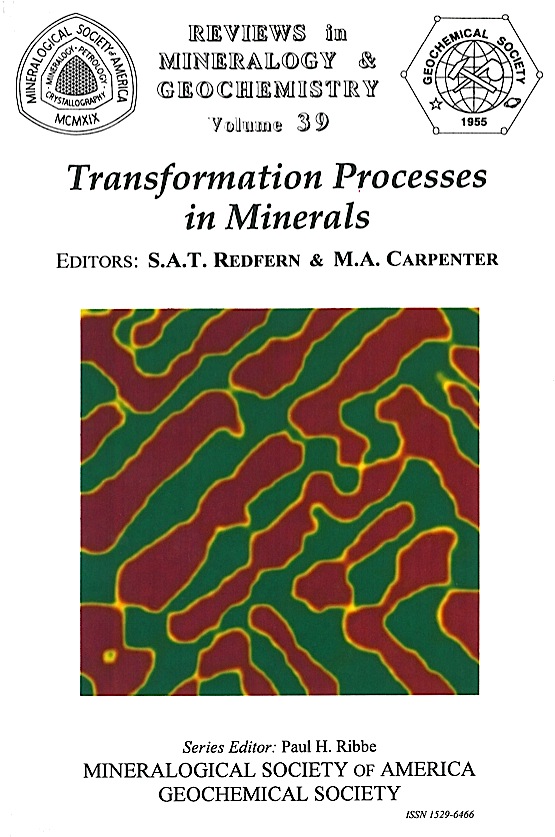
Title Page
p. i
Copyright
p. ii
Preface
p. iii - iv
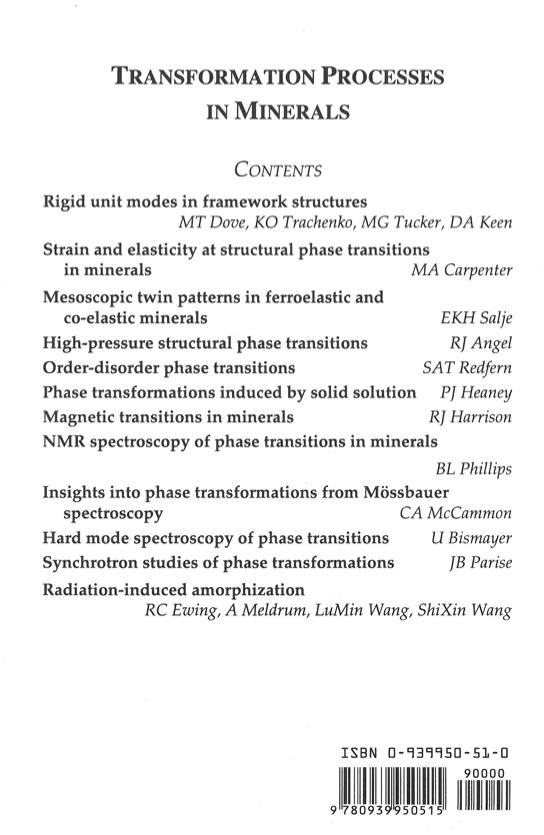
Table of Contents
p. v - x
Chapter 1. Rigid unit modes in framework structures
by Martin T. Dove, Kostya O. Trachenko, Matthew G. Tucker, David A. Keen, p. 1 - 34
Chapter 2. Strain and elasticity at structural phase transitions in minerals
by Michael A. Carpenter, p. 35 - 64
Chapter 3. Mesoscopic twin patterns in ferroelastic and co-elastic minerals
by Ekard K. H. Salje, p. 65 - 84
Chapter 4. High-pressure structural phase transitions
by Ross J. Angel, p. 85 - 104
Chapter 5. Order-disorder phase transitions
by Simon A. T. Redfern, p. 105 - 134
Chapter 6. Phase transformations induced by solid solution
by Peter J. Heaney, p. 134 - 174
Chapter 7. Magnetic transitions in minerals
by Richard J. Harrison, p. 175 - 202
Chapter 8. NMR spectroscopy of phase transitions in minerals
by Brian L. Phillips, p. 203 - 240
Chapter 9. Insights into phase transformations from Mössbauer spectroscopy
by Catherine A. McCammon, p. 241 - 264
Chapter 10. Hard mode spectroscopy of phase transitions
by Ulli Bismayer, p. 265 - 284
Chapter 11. Synchrotron studies of phase transformations
by John B. Parise, p. 285 - 318
Chapter 12. Radiation-induced amorphization
by Rodney C. Ewing, Aikiviathes Meldrum, LuMin Wang, and ShiXin Wang, p. 319 - 362