Mineralogical Society of America, Founded December 30, 1919
Order Publications Online (25% discount for MSA, CMS and GS members, except shipping)
MinPubs.org Pay-Per-View GeoScienceWorld Pay-Per-View
1983, 1990 i-xii + 399 pages. ISBN 0-939950-15-4; ISBN13 978-0-939950-15-7
This volume of Reviews in Mineralogy attempts to synthesize our present understanding of certain aspects of the mineralogy and chemistry of the rock-forming carbonates. Hopefully, it reflects the presently more active areas of research. This review follows, by ten years, a major assessment of (sedimentary) carbonate minerals by Lippmann (1973). There is only minor overlap of subject material, and I hope that this difference reflects fairly how this field has developed.
In some respects carbonates are unique, for they are one of the few mineral groups providing an abundant record of biological, physical, and chemical processes throughout much of geologic time. Because of their relative importance in sedimentary rocks, lowtemperature examples are given more emphasis here. Moreover, the obvious correlation with energy resources has been a significant factor contributing to the current resurgence of interest in this area. However, the broader interest in carbonates is also a reflection of their widespread occurrence in vastly different geologic environments, including metamorphic and igneous settings, as well as an appreciation of their role in both atmospheric and oceanic chemistry, both past and present.
In this volume, some of the papers are general (i.e., those addressing crystal chemistry and phase relations), and they provide overviews of a fundamental nature and are of interest to many. Others are more specialized in coverage and generally reflect the different approaches used in carbonate geochemistry. The final chapter introduces transmission electron microscopy, a relatively new and powerful technique for mineralogical research that has great potential in carbonate research.
Owing to the short time interval between the completion of manuscripts and publication, much of the newer material in this volume is still "fresh." The various reviewers, all gratefully acknowledged, were expeditious in their efforts. A hurried schedule, however, allows for unnoticed errors to persist; these should be brought to my attention.
Richard J. Reeder, Stony Brook, New York, USA
September 1, 1983
PREFACE TO THE SECOND PRINTING
Interest in carbonate research has continued at an ever-hurried pace since this book was first printed. While the individual chapters could not be revised in this second printing to include the many new findings, a partial listing of noteworthy papers that have since appeared are given in an Appendix at the end of the volume (p. 395-399). These papers are arranged by chapters corresponding roughly to the subject area discussed. In addition, incomplete references from the first printing are listed in this appendix. The assistance of the authors and especially of Paul Ribbe is greatly appreciated.
Richard J. Reeder, Stony Brook, New York, USA
February 1, 1990
Several years ago, Rich Reeder, who was and still is very excited about new vistas of research centered around application of the transmission electron microscope to carbonates, volunteered to organize a short course on carbonates for the Mineralogical Society of America. His success is commemorated by this volume with its fifteen authors, nine of whom lectured October 28-30, 1983, just prior to the annual meetings of M.S.A. and the Geological Society of America at Indianapolis, Indiana.
Paul H. Ribbe, Blacksburg, Virginia, USA
September 1, 1983
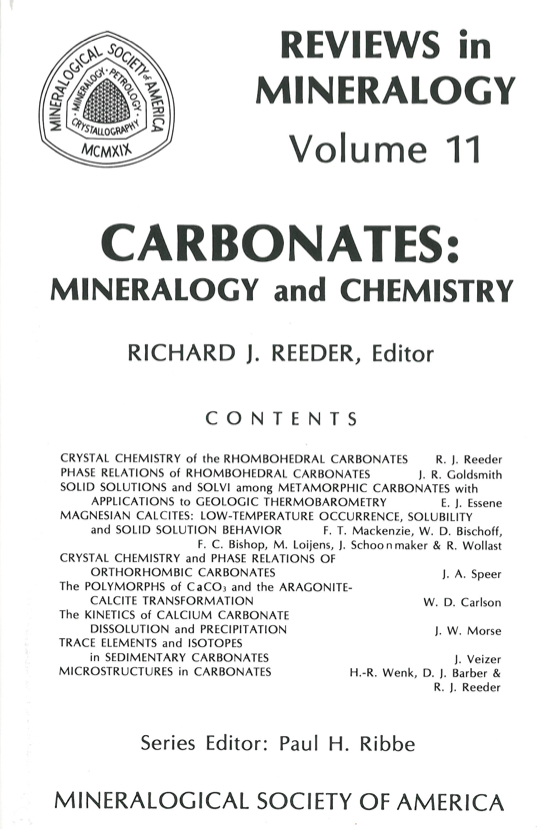
Title Page
p. i
Copyright
p. ii
Foreword, Acknowledgements, & Preface
p. iii - iv
Table of Contents
p. v - xii
Chapter 1. Crystal Chemistry of the Rhombohedral Carbonates
by Richard J. Reeder, p. 1 - 48
Chapter 2. Phase Relations of Rhombohedral Carbonates
by Julian R. Goldsmith, p. 49 - 76
Chapter 3. Solid Solutions and Solvi Among Metamorphic Carbonates with Applications to Geologic Thermobarometry
by Eric J. Essene, p. 77 - 96
Chapter 4. Magnesian Calcites: Low-Temperature Occurrence, Solubility and Solid Solution Behavior
by Fred T. Mackenzie, William D. Bischoff, Finlay C. Bishop, Michele Loijens, Jane Schoonmaker, and Roland Wollast, p. 97 - 144
Chapter 5. Crystal Chemistry and Phase Relations of Orthorhombic Carbonates
by J. Alexander Speer, p. 145 - 190
Chapter 6. The Polymorphs of CaCO3 and the Aragonite-Calcite Transformation
by Willima D. Carlson, p. 191 - 226
Chapter 7. The Kinetics of Calcium Carbonate Dissolution and Precipitation
by John W. Morse, p. 227 - 264
Chapter 8. Trace Elements and Isotopes in Sedimentary Carbonates
by Jan Veizer, p. 265 - 300
Chapter 9. Microstructures in Carbonates
by Hans-Rudolf Wenk, David J. Barber, and Richard J. Reeder, p. 301 - 368
References
p. 369 - 394
Appendix to Second Printing
p. 395 - 399